
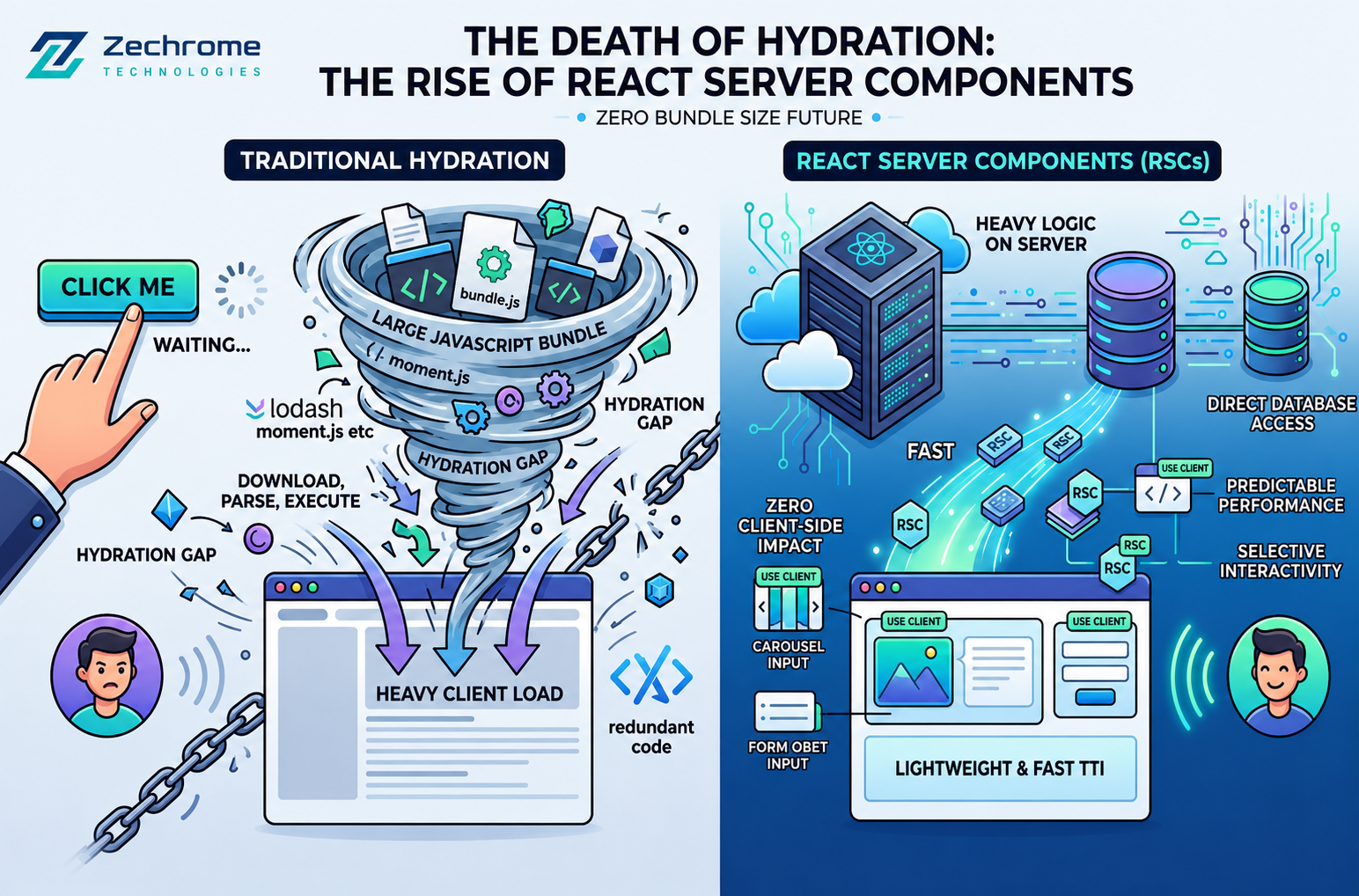

For years, the “Hydration Gap” has been the silent killer of performance. We’ve all been there: the server sends the HTML, the page looks ready, but the user clicks a button and… nothing. The browser is too busy downloading, parsing, and executing a massive JavaScript bundle to actually respond.
In 2026, the industry has officially hit a breaking point with “Heavy Client” architectures. At Zechrome, we’ve moved beyond the era of sending the entire kitchen sink to the browser. Here is why React Server Components (RSCs) have officially replaced traditional hydration as our gold standard for full-stack development.
The Problem: The Hydration Tax
Traditional SSR (Server-Side Rendering) was a great first step, but it came with a hidden tax. Even though the server rendered the HTML, we still had to send the same code to the client so React could “hydrate” the page and make it interactive.
As applications grew, so did the bundles. We were effectively paying for the same UI twice:
- Server-side: To generate the initial view.
- Client-side: To download the logic that already ran on the server.
The 2026 Shift: Zero-Bundle-Size Components
React Server Components change the fundamental contract of the web. Instead of hydrating every single div and span, RSCs allow us to keep the heavy logic on the server.
What this looks like in practice:
- Zero Client-Side Impact: Large dependencies (like Markdown parsers or date-formatting libraries) stay on the server. They never reach the user’s device.
- Direct Database Access: We can now query our databases directly inside our components. No more redundant API layers or useEffect fetch waterfalls that clutter the client-side logic.
Predictable Performance: Whether your user is on a flagship workstation or a mid-range mobile device, the execution cost is shifted to our high-performance server environment.
Why Developers are Making the Switch
From a developer’s perspective, RSCs simplify the mental model of building complex apps.
1. Goodbye, State Management Bloat
We no longer need massive Redux or MobX stores just to cache data that was already available on the server. By fetching at the component level on the server, the “source of truth” stays where it belongs.
2. Automatic Code Splitting
RSCs treat code splitting as a first-class citizen. React automatically determines which parts of the tree need to be interactive (Client Components) and which can remain static (Server Components). This happens without the manual React.lazy boilerplate we used to struggle with.
3. Enhanced Security
Sensitive logic, API keys, and internal business rules stay behind the firewall. Since the code for a Server Component never leaves the server, the attack surface for the client-side application is significantly reduced.
Is Hydration Completely Dead?
Not quite it’s just evolving. We still use Client Components (using the ‘use client’ directive) for the parts of the UI that require immediate feedback, like carousels, modals, or real-time inputs.
However, the “Death of Hydration” refers to the end of the Full-Page Hydration era. We are now in the age of Selective Interactivity. We only hydrate what is absolutely necessary, leaving the rest of the page lightweight and lightning-fast.
At Zechrome, we believe that the best JavaScript is the code you don’t have to send. By embracing React Server Components, we’ve seen a drastic reduction in Time to Interactive (TTI) and a massive improvement in overall developer experience.
2026 isn’t just about faster frameworks; it’s about smarter architectures. It’s time to stop sending bundles and start sending value.
