


Artificial Intelligence has quietly become a core part of modern web applications. What once felt experimental is now practical, accessible, and extremely valuable especially for products built with React and Node.js.
At Zechrome Technologies, we recently integrated AI into a production-ready React and Node.js application. The focus was not hype, but usability building intelligent features that actually improve the product for users and simplify operations for businesses.
This blog shares how AI fits naturally into a modern JavaScript stack and what developers and decision-makers should know before adopting it.
AI as a Service, Not a Feature:
One of the biggest mistakes teams make is tightly coupling AI logic with UI or business code. Instead, we treated AI as an external capability exposed through backend APIs.
This approach ensured:
- Clear separation of concerns
- Easier debugging and testing
- Independent evolution of AI logic
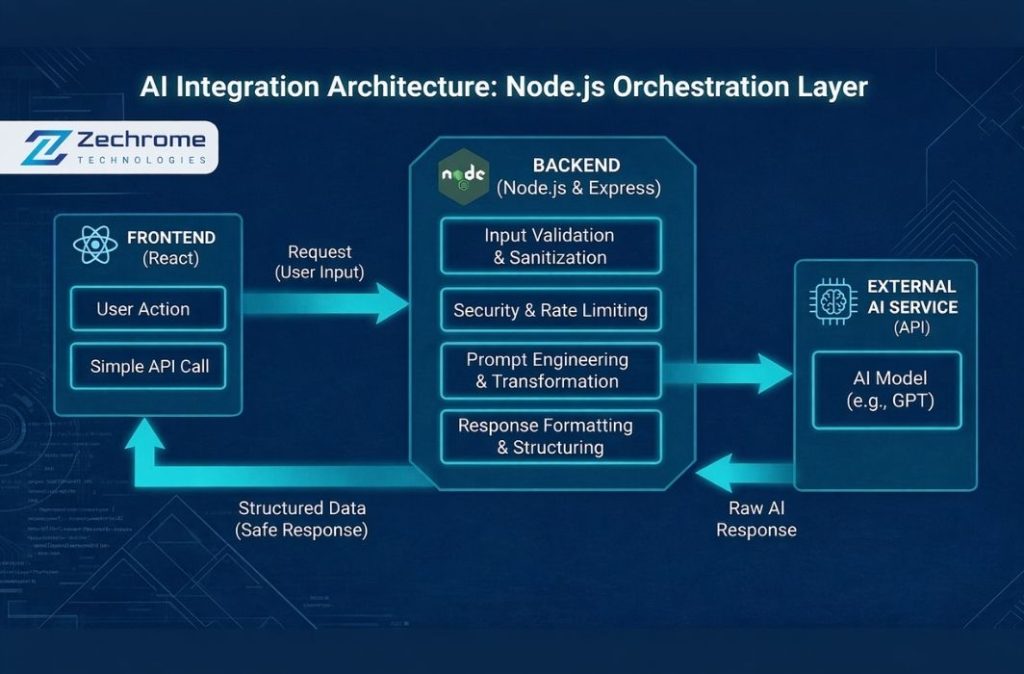
React remained responsible only for user interaction, while Node.js controlled all AI-related operations.
Backend Architecture That Keeps AI Predictable:
Node.js acted as the orchestration layer between users and AI models. Every request passed through validation, authorization, and transformation before reaching the AI service.
This gave us control over:
- Input sanitization
- Prompt consistency
- Response formatting
- Business rule enforcement
AI responses were never sent directly to the frontend. Instead, Node.js converted them into structured, predictable data that React could safely render.
Frontend Integration Without UI Complexity:
From the React side, AI felt like any other API call. Components triggered requests, handled loading states, and rendered results.
There was no prompt logic, token handling, or AI configuration inside UI components. This made the frontend:
- Easier to maintain
- Faster to iterate
- Resistant to AI model changes
For developers, this means you can swap or upgrade AI models without rewriting frontend logic.
Managing Performance and AI Costs:
AI calls can be expensive and slow if misused. To avoid this, we optimized how and when AI was invoked.
Common strategies included:
- Avoiding unnecessary AI requests
- Reusing responses where applicable
- Limiting payload size
- Tracking usage patterns
This kept the application responsive while maintaining predictable operational costs.
Security Considerations Developers Should Not Ignore:
AI integration introduces new security risks. We ensured:
- No AI keys were exposed to the client
- Requests were rate-limited
- Sensitive data was never sent blindly to AI services
By centralizing AI access in Node.js, the system remained secure and compliant with best practices.
AI integration does not have to be complex, risky, or overwhelming. When combined with a modern JavaScript stack like React and Node.js, it becomes a practical tool for building smarter applications.
At Zechrome Technologies, we focus on integrating AI in a way that is secure, scalable, and genuinely useful helping teams build intelligent products that are ready for real-world use.
Thinking about adding AI to your web application?
If you’re planning to integrate AI into your React, Node.js, or full-stack application, Zechrome Technologies can help you design and implement it the right way.
