
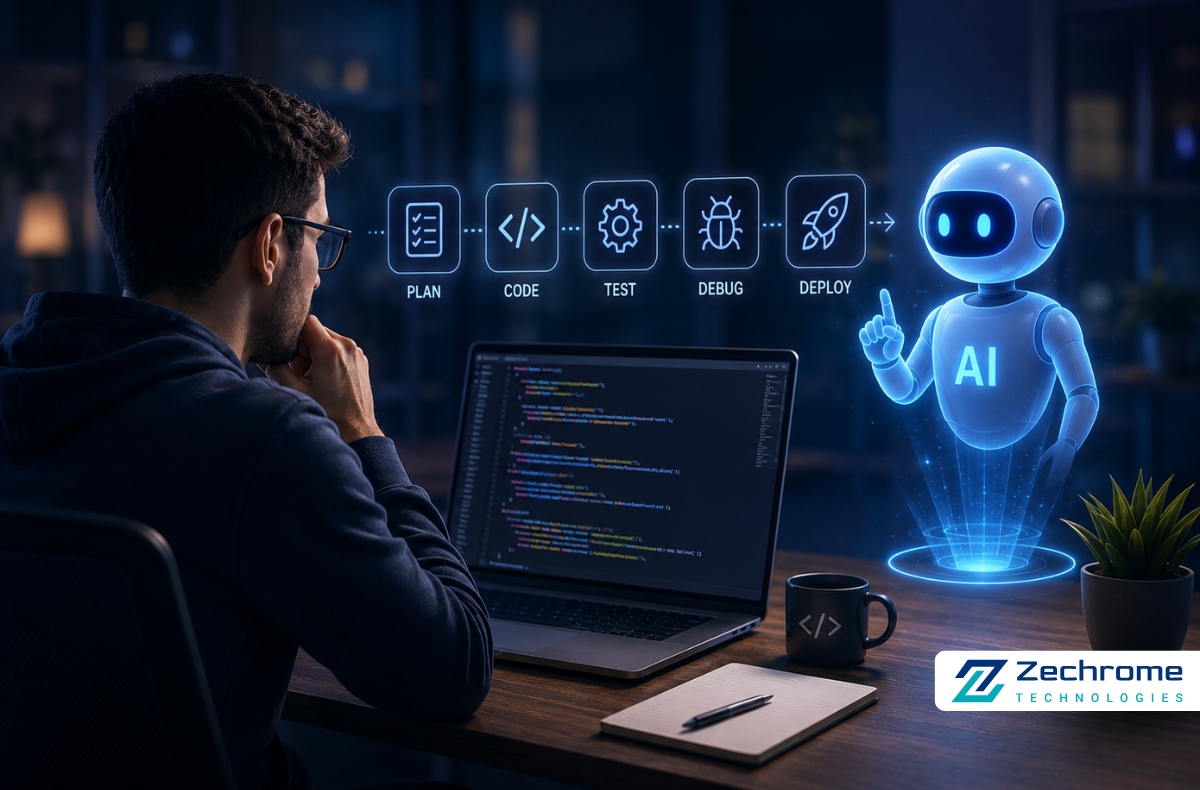

AI is moving beyond answering questions and generating code. Developers can now use AI agents to plan, execute, test, debug, and automate multi-step software tasks.
Software development is entering a new phase.
For years, developers used AI mainly as a coding assistant. They asked it to generate a function, explain an error, write a query, or suggest a solution.
Today, AI coding agents are taking a more active role.
Instead of responding to one prompt at a time, an AI agent can understand a larger development task, inspect a codebase, make changes across multiple files, run tests, investigate failures, and continue working until the task reaches a defined outcome.
This shift is often described as agentic software development.
What Are AI Coding Agents?
An AI coding agent is an AI system designed to perform multi-step software engineering tasks rather than simply generate code.
For example, a developer might ask an agent to add a password-reset feature to an existing application.
The agent may inspect the authentication system, understand the project structure, identify the relevant database models and APIs, implement the feature, create tests, run those tests, and investigate any failures.
The developer provides the goal and constraints while the agent handles more of the execution.
This creates an important difference:
AI assistants primarily provide answers. AI agents can work through tasks.
How AI Agents Are Changing Development
AI agents are becoming useful across different stages of the software development lifecycle.
1. Understanding Existing Codebases
One of the most time-consuming tasks for developers is understanding an unfamiliar project.
Large applications may contain thousands of files, multiple services, complex dependencies, and years of technical decisions.
AI agents can help explore project structures, identify related files, understand existing patterns, and locate the code responsible for a particular feature or error.
This can make onboarding and legacy-code work faster.
2. Building Features
Traditional AI coding usually involves requesting individual pieces of code.
Agentic coding allows developers to describe a larger requirement.
For example, instead of asking for a single API endpoint, a developer can ask an agent to implement a complete feature while following the existing architecture and testing practices.
The agent can potentially work across backend logic, database changes, APIs, frontend components, and tests.
This is especially useful for repetitive development tasks.
3. Testing and Debugging
Testing is becoming one of the most valuable areas for AI agents.
An agent can help generate tests, run existing test suites, analyze failures, and suggest or implement fixes.
The workflow becomes more iterative.
The agent makes a change, runs the tests, observes the result, identifies problems, and attempts another change.
This feedback loop can reduce the amount of manual debugging required for routine issues.
However, developers still need to verify whether the tests actually cover the important business requirements.
4. Refactoring and Migration
Modern applications frequently require dependency updates, framework migrations, API changes, or code refactoring.
These tasks can involve hundreds of repetitive changes.
AI agents can help identify affected files, make consistent modifications, and run tests to find compatibility issues.
For developers working with large or legacy applications, this can be particularly valuable.
From Prompt Engineering to Specification Engineering
Another important change is how developers communicate with AI.
Early AI coding workflows focused heavily on prompts such as:
“Write a login API.”
Agentic development requires more context.
A better instruction might explain the expected authentication behavior, existing architecture, security requirements, error handling, testing requirements, and restrictions on changing existing APIs.
This means developers increasingly need to think in terms of specifications rather than simple prompts.
Clear requirements help agents make better decisions.
Developers who understand their application’s architecture and can clearly define expected behavior will generally get more useful results from AI agents.
AI Agents Are Not Replacing Software Engineers
The growing capability of AI agents does not remove the need for developers.
In many cases, it changes what developers spend their time doing.
Instead of manually handling every repetitive coding task, developers can spend more time on:
- System architecture
- Technical decisions
- Security
- Performance
- Business requirements
- Code review
- Testing strategy
- Production reliability
AI can generate an implementation, but developers still need to determine whether that implementation is correct, secure, maintainable, and appropriate for the project.
This is particularly important for production applications where a small mistake can create security, performance, or reliability problems.
The Importance of Human Oversight
Autonomous coding sounds attractive, but more autonomy also creates new risks.
An AI agent can misunderstand a requirement, modify the wrong part of an application, introduce a security vulnerability, or produce code that passes tests but creates long-term maintenance problems.
For this reason, human-in-the-loop development remains important.
A practical workflow is to let the agent investigate and implement the task while developers control important decisions, review changes, run appropriate validation, and approve what reaches production.
The goal should not be maximum autonomy.
The goal should be safe and useful autonomy.
What Developers Should Learn Next
Developers do not need to become AI researchers to take advantage of this trend.
Strong fundamentals remain extremely important.
Developers should continue building skills in programming, databases, APIs, system design, Git, testing, security, and cloud development.
At the same time, they should learn how to work effectively with AI coding agents.
This includes understanding how to:
- Write clear technical requirements
- Provide useful project context
- Define acceptance criteria
- Break complex problems into manageable tasks
- Build reliable automated tests
- Review AI-generated code
- Control agent permissions
- Use Git and pull requests effectively
The better the development environment and evaluation process, the more useful AI agents become.
Where Agentic Development Is Heading
The next stage of AI-assisted development is likely to focus less on generating isolated code and more on completing complete engineering workflows.
Developers may increasingly use agents for tasks such as investigating issues, preparing pull requests, updating documentation, improving test coverage, migrating code, and handling repetitive maintenance work.
Multi-agent workflows are also emerging, where different AI agents can specialize in planning, coding, testing, security analysis, or review.
But adding more agents does not automatically produce better software.
Good engineering practices, strong testing, clear requirements, and human judgment will remain essential.
The Future Is Developer + AI Agent
AI agents are changing the role of AI in software development.
The shift is moving from:
Prompt → Code
toward:
Goal → Plan → Execute → Test → Review
That is a much bigger change than AI-generated code alone.
Developers are not simply becoming faster programmers. They are increasingly becoming orchestrators of software development workflows.
The most valuable skill may not be knowing how to write every line manually.
It may be knowing what should be built, how it should work, what constraints matter, how to evaluate the result, and where AI can safely take over repetitive work.
AI agents are still evolving, but one thing is becoming clear: the future of software development will not be about choosing between developers and AI.
It will be about learning how to make both work effectively together.
The question is no longer “Can AI write this code?”
The better question is “What part of my development workflow can AI safely handle next?”
