
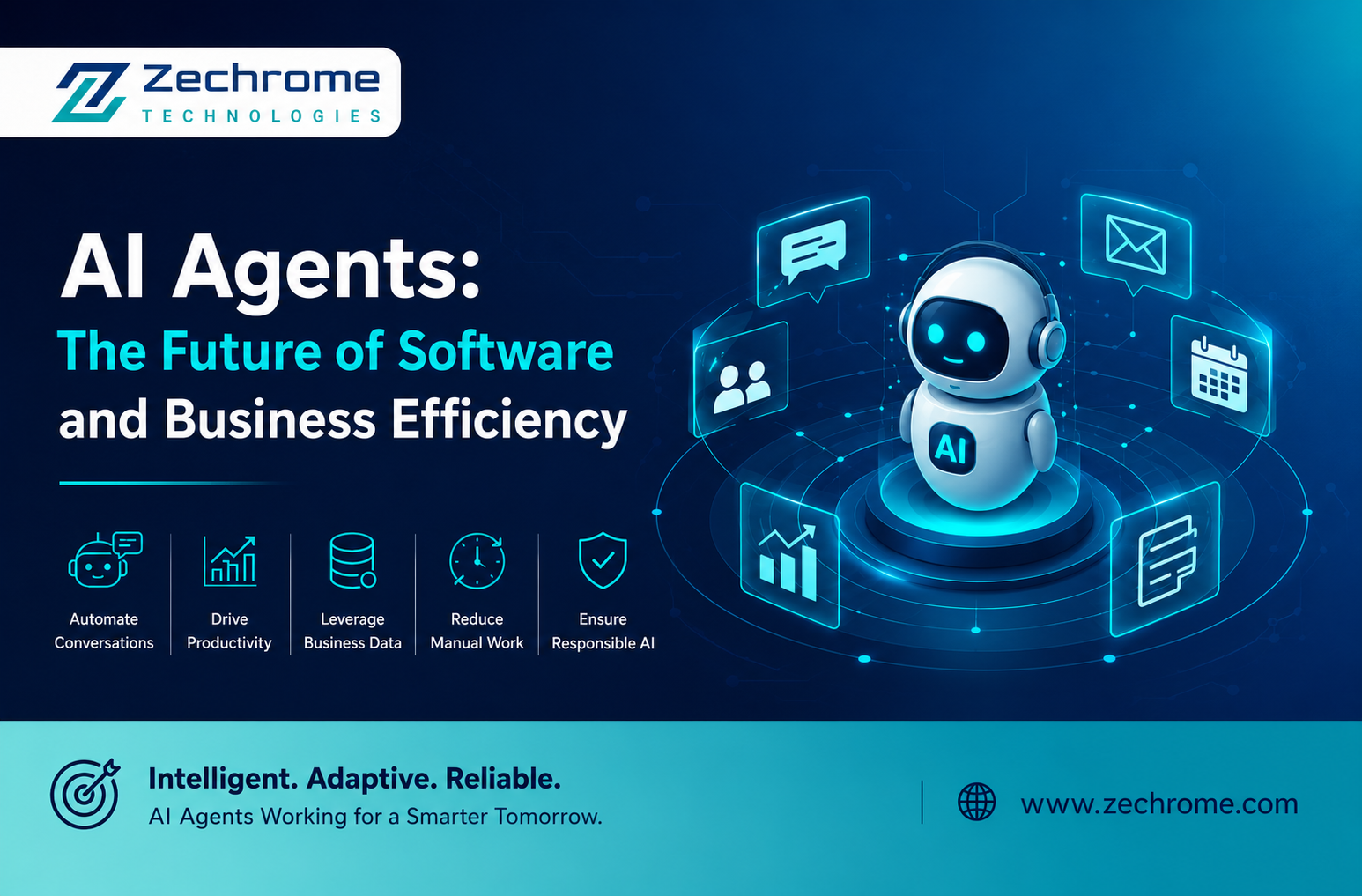

For years, Software as a Service (SaaS) has been the foundation of modern businesses. Companies have relied on cloud-based software to manage everything from sales and customer support to finance and operations. But a new shift is beginning to reshape how software delivers value.
Instead of simply providing tools that people use, Artificial Intelligence (AI) is enabling software to complete tasks, make decisions within defined limits, and support everyday business operations with minimal manual effort. This is where AI agents are gaining attention.
Many technology leaders believe the next wave of innovation will focus less on traditional applications and more on intelligent systems that can work alongside people.
What Is an AI Agent?
An AI agent is a software system designed to understand a goal, process information, and carry out tasks using available data and connected tools. Unlike traditional software that waits for every user instruction, AI agents can perform a sequence of actions to help achieve a specific outcome.
For example, an AI agent may:
Answer customer questions using company knowledge. Organize emails and schedule meetings. Generate reports from business data. Monitor systems and alert teams when attention is needed. Assist employees with repetitive administrative tasks.
These agents are built to support human work—not replace human judgment.
Why Founders Should Pay Attention
Businesses are looking for ways to improve productivity without increasing complexity. AI agents offer an opportunity to automate routine work while allowing teams to focus on higher-value activities.
For founders, this opens several possibilities:
Faster response times for customers.
Reduced manual work across departments.
Better use of business data.
More scalable operations without adding unnecessary software layers.
Instead of creating another dashboard for users to manage, many startups are exploring solutions where AI completes the work in the background.
How AI Agents Differ from Traditional SaaS
Traditional SaaS platforms provide features that users operate manually. AI agents, on the other hand, are designed to assist with workflows by combining reasoning, automation, and data access.
Think of it this way:
Traditional SaaS: “Here are the tools. You complete the task.”
AI Agent: “Tell me the goal, and I’ll help carry out the steps.”
This change creates a more natural and efficient way of interacting with software.
Where AI Agents Are Making an Impact
AI agents are already being explored across many industries, including:
Customer service
Sales and marketing
Software development
Human resources
Finance and accounting
Manufacturing operations
Healthcare administration
Logistics and supply chain management
As AI technology continues to improve, these use cases are expected to expand.
Building AI Responsibly
While AI agents offer exciting opportunities, responsible implementation is essential. Organizations should ensure that AI systems operate with appropriate oversight, protect sensitive information, and provide transparency about how decisions or recommendations are generated.
Human review remains important, especially for tasks involving critical business decisions or customer-facing interactions.
The Road Ahead
The future of software is becoming more intelligent, adaptive, and task-oriented. AI agents are not replacing every application, but they are changing how businesses think about automation and productivity.
For founders, the opportunity is no longer just building software that people use. Increasingly, it is about building software that helps people accomplish more with greater efficiency.
The companies that combine practical AI solutions with strong user experience, reliability, and responsible design are likely to be well positioned as this technology continues to evolve.
As the AI landscape grows, one thing is becoming clear: software is moving beyond being a tool it is becoming an active partner in getting work done.
