
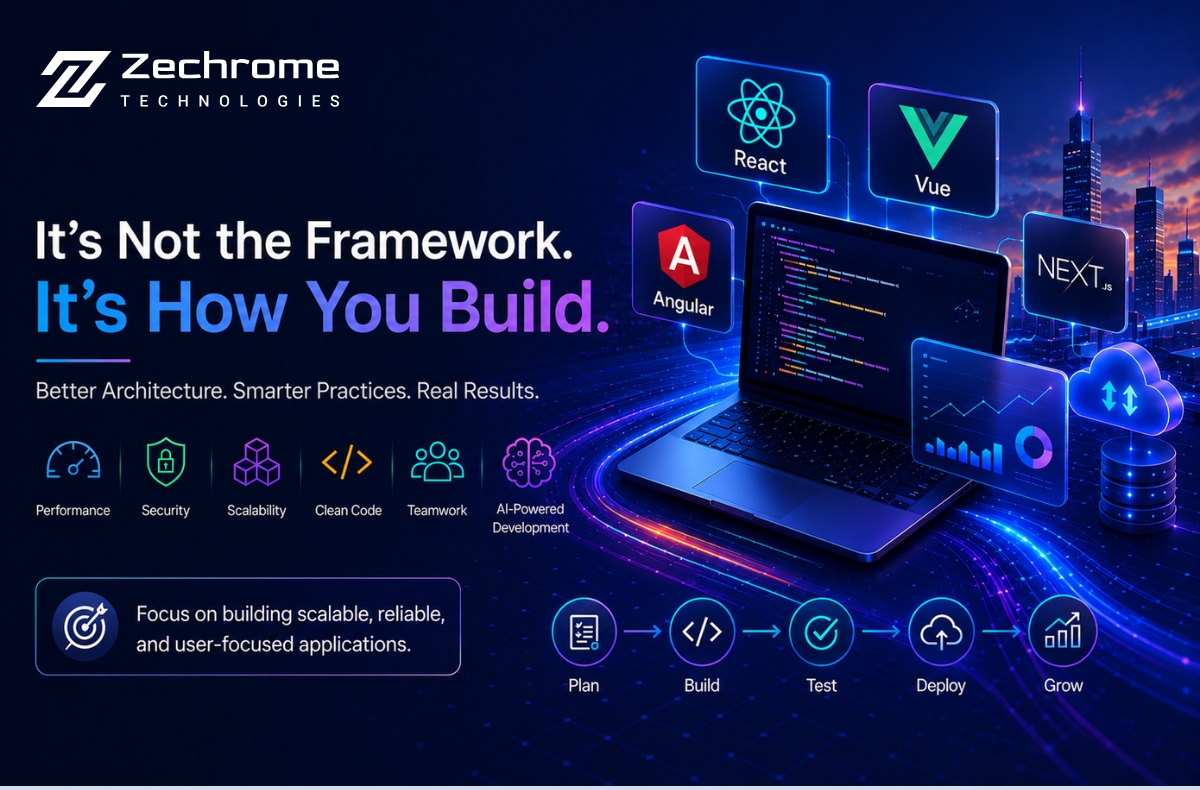

Every few weeks, a new debate starts in the tech world.
React vs Vue. Angular vs React. Next.js vs everyone else.
Developers spend hours discussing which framework is faster, easier to learn, or better for future projects. While these conversations are interesting, they often miss a much bigger issue.
Many companies spend a lot of time choosing the “right” JavaScript framework, but still struggle with slow development, performance issues, scalability problems, and rising maintenance costs.
That’s because the framework is usually not the real problem.
Modern Frameworks Are Already Powerful
Today’s JavaScript frameworks have become incredibly capable.
Whether you choose React, Vue, Angular, or another modern framework, you get access to features like reusable components, state management, performance optimization, and large developer communities.
For most business applications, all of these frameworks can deliver excellent results when used correctly.
In reality, users rarely care which framework is behind an application.
They care about whether it works well.
The Bigger Problem Is How Applications Are Built
A common mistake many organizations make is focusing too much on technology choices and not enough on software planning.
Think of it this way: choosing a framework is like choosing the materials for a building. If the design is weak, the building will still have problems no matter how good the materials are.
Many software projects face challenges because of:
- Poor application architecture
- Difficult system integrations
- Weak security planning
- Lack of scalability
- Poor code maintenance
- Inconsistent development practices
These issues can affect a project’s success far more than the choice between React, Vue, or Angular.
Development Speed Matters More Than Ever
In today’s competitive market, businesses need to launch features quickly and adapt to changing customer needs.
This is why successful companies focus on:
- Efficient development processes
- Automated testing
- Continuous integration and deployment (CI/CD)
- Good documentation
- Team collaboration
- Code quality
A well-organized development team can achieve great results with almost any modern framework.
AI Is Changing Software Development
One of the biggest trends in technology today is AI-assisted development.
Developers are using AI tools to write code faster, find bugs, create documentation, and automate repetitive tasks.
As AI becomes part of everyday software development, productivity and innovation are becoming more important than framework comparisons.
The companies that succeed will be the ones that combine modern technology with smart development practices.
What Users Actually Care About
Most users don’t know whether an application was built using React, Vue, or Angular.
What they do notice is:
- Fast loading speed
- Easy navigation
- Smooth user experience
- Mobile responsiveness
- Reliability
- Security
If an application delivers these things consistently, the technology behind it becomes much less important.
The Question Businesses Should Ask
Instead of asking:
“Which JavaScript framework is the best?”
Businesses should ask:
“How can we build software that is scalable, reliable, and easy to maintain?”
That question leads to better decisions and better long-term results.
How Zechrome Technologies Helps
At Zechrome Technologies LLP, we help businesses focus on what truly matters—building software that delivers results.
Our team combines modern JavaScript technologies with scalable architecture, cloud solutions, AI-powered development practices, and user-focused design to create applications that are built for long-term growth.
Rather than getting caught up in framework debates, we help organizations choose the right technology stack based on their business goals and future requirements.
Final Thoughts
React, Vue, Angular, and other frameworks will continue to evolve. New frameworks will appear, and developers will continue comparing them.
But successful software projects are rarely successful because of a framework alone.
They succeed because they are built on strong architecture, efficient development practices, and a clear focus on solving real business problems.
The real challenge isn’t choosing the perfect framework.
It’s building software that creates real value for users and businesses.
