
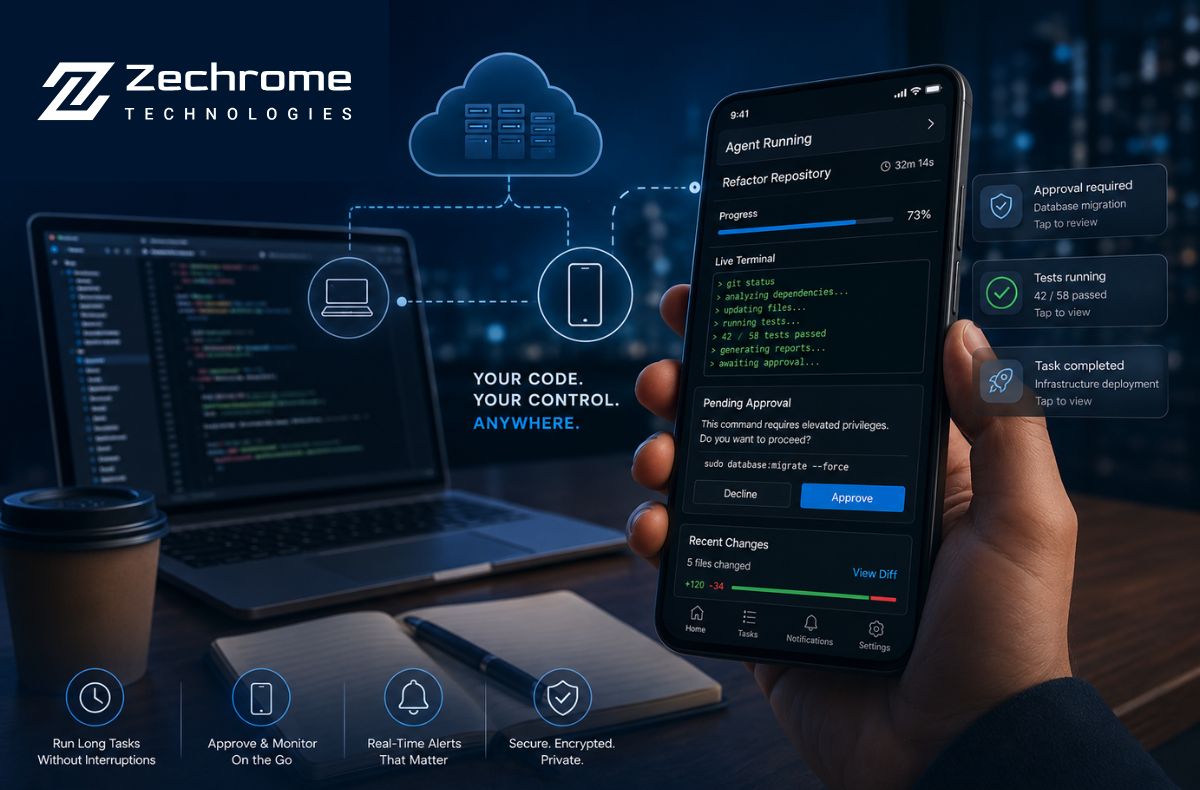

Imagine kicking off a complex, multi-file database migration or a massive repository refactor on your workstation. It is a task that will take your AI coding agent 30 to 45 minutes to execute. Normally, you are chained to your desk, waiting to approve a terminal command or resolve a breaking dependency change. If you walk away to grab coffee, the entire workflow grinds to a halt.
Not anymore.
The battle for AI engineering dominance just shifted from your desktop IDE directly to your pocket. With OpenAI’s recent rollout of Codex mobile monitoring within the ChatGPT app (iOS and Android), following Anthropic’s release of Claude Code Remote Control, the software development workflow has officially entered the era of the Mobile Developer Cockpit.
At Zechrome Technologies LLP, we closely track how digital transformation, automation, and advanced software architectures reshape productivity. This move isn’t about writing lines of code on a 6-inch phone screen it’s a fundamental shift in how developers supervise autonomous agentic workflows.
Mobile Supervision, Not Mobile Typing
Let’s clear up a common misconception: Nobody wants to write complex React components or debug backend endpoints on a mobile keyboard. That isn’t what this update is for.
Instead, the mobile interface acts as a remote command center for long-running developer operations. While your local machine, cloud devbox, or remote server acts as the heavy-duty host handling the file writes, shell commands, and git operations, your phone acts as the control panel.
Comparing the Mobile Approaches
OpenAI Codex (Mobile Preview)
- Mobile Access Point: Integrated into the core ChatGPT Mobile App on iOS and Android.
- Primary Connection: QR-code pairing from host machine (macOS focus, Windows rolling out).
- Execution Boundary: Supports both connected local hosts and isolated cloud sandboxes.
- Interactivity: View live project context, diffs, terminal logs, and approve commands.
- Plan Availability: Available across all tiers (including Free/Go preview).
Anthropic Claude Code (Remote Control)
- Mobile Access Point: Integrated into the Claude Mobile App and Web interface.
- Primary Connection: Terminal command (claude remote-control) with a secure QR toggle.
- Execution Boundary: Local-first; executes strictly on your local machine and local tools.
- Interactivity: Monitor tool progress, approve actions, and receive push notifications for manual steps.
- Plan Availability: Research preview available on Pro and Max plans.
Why the “Human-in-the-Loop” Interrupt Dictates Mobile AI
As AI coding agents evolve from simple autocompletes to autonomous operators—tools capable of executing multi-step goals over hours of wall-clock time—the biggest bottleneck isn’t the model’s speed. It’s the human interrupt.
Agents frequently hit forks in the road where they require human judgment:
- “I found a breaking change in a shared utility file. Should I rewrite the utility or refactor the dependent files?”
- “This command requires administrative database privileges. Do you approve?”
If you aren’t at your desk to hit “Y”, the agent idles, destroying development velocity. By routing live terminal streams, diff summaries, and push notifications to iOS and Android, OpenAI and Anthropic are turning software engineers from active code-writers into high-level system overseers.
What This Means for Engineering Teams and Product Managers
For tech enterprises, system integrators, and software teams, this mobile agent continuity brings three major architectural and operational shifts:
- Eliminating the Context-Switching Penalty: Developers no longer have to leave long-running background tasks running blindly. They can step into a meeting, review project state on their phone, and approve an action mid-discussion without disrupting their day.
- Data Residency vs. Cloud Sandbox Flexibilities: Anthropic’s local-first architecture keeps your code entirely on your machine, using the cloud solely to route encrypted UI inputs. OpenAI provides a multi-boundary approach, allowing you to alternate between secure cloud sandboxes and connected local hardware.
- The Rise of Asynchronous Development: Engineers can queue up system-wide unit tests or infrastructure deployments at the end of the day and handle the final validation checks or deployment permissions via push notifications while away from their desks.
The Next Frontier for Software Automation
The rapid sequence of releases from Anthropic and OpenAI proves that the race for developer mindshare is no longer just about context windows or benchmark scores. It is about workflow integration.
At Zechrome Technologies LLP, we believe that the teams who master these multi-device, agentic workflows will achieve unprecedented product velocity. The terminal is no longer bound to a physical desk—it’s in your pocket, running around the clock.
What are your thoughts on managing development workflows from your phone? Is mobile agent control a gimmick, or is it the future of DevOps throughput? Let us know in the comments below!
