
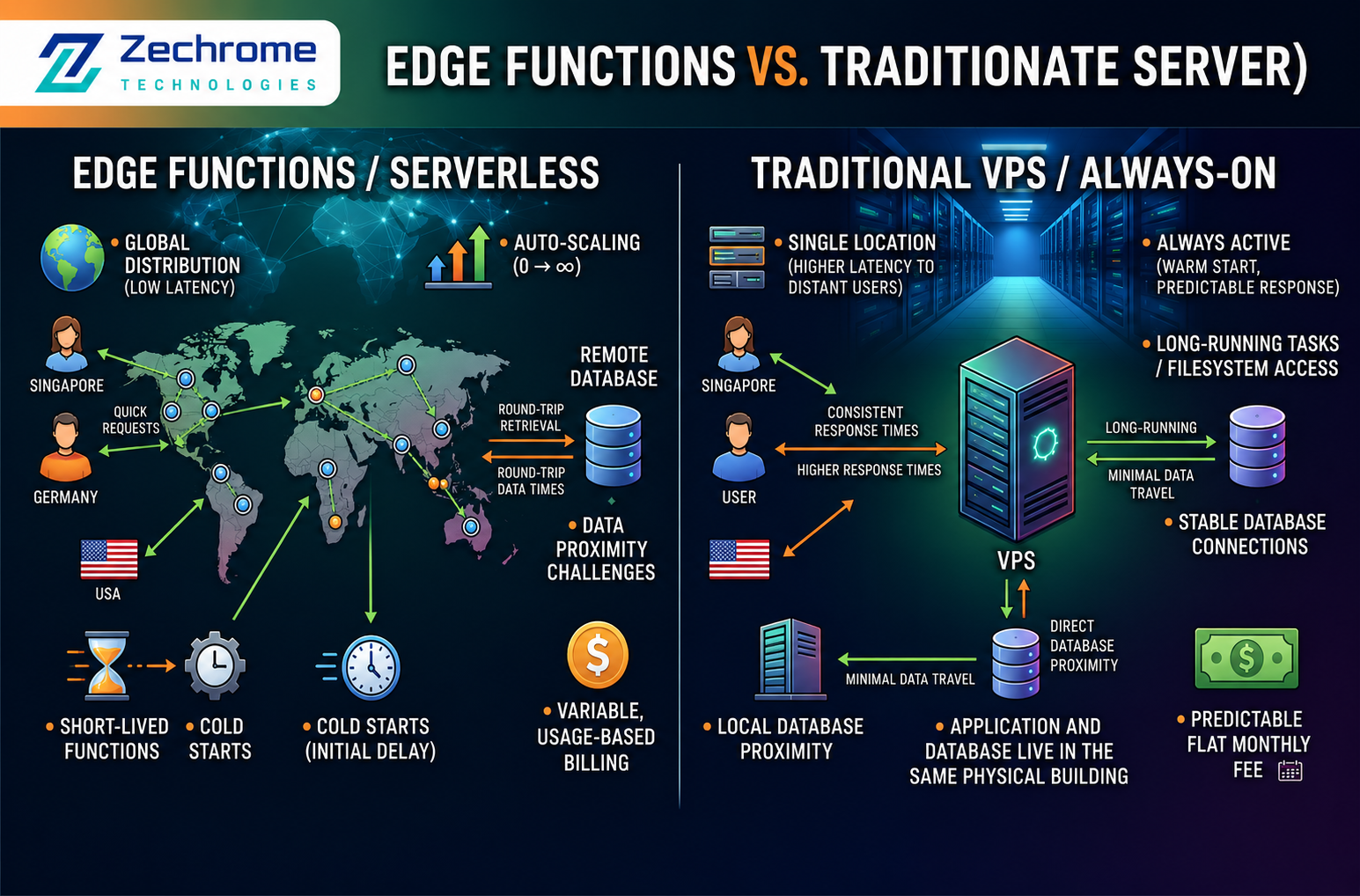

For the past few years, anyone building web applications has heard the same advice: go serverless or get left behind. The industry promised a world where you never have to manage servers, your app scales automatically to millions of users, and you only pay for the exact milliseconds your code runs.
Then came Edge Computing (through platforms like Vercel and Cloudflare). This moved your code even closer to your users by running it on servers scattered across the globe instead of a single data center.
But as time goes on, many engineering teams are facing a sudden reality check. High monthly bills, unexpected slowdowns, and complicated database issues are making developers rethink this path. Today, many startups and growing companies are asking an unexpected question: Should we just move our application back to a traditional Virtual Private Server (VPS)? At Zechrome Technologies LLP, we help businesses choose the right setup for their software. Let’s break down the real trade-offs between Edge Functions and a traditional VPS in simple terms so you can decide what is best for your project.
The Core Performance Battle: Latency vs. Cold Starts
The biggest reason companies switch to Edge functions is to reduce latency (the time it takes for data to travel from your server to the user). Instead of a user in India waiting for a server in the United States to respond, an Edge node right in India handles the request instantly.
The Catch: Cold Starts
While Edge functions are fast, they have a hidden weakness called Cold Starts. When your application doesn’t get traffic for a little while, the platform shuts down your code to save resources. When the next user visits, they have to wait anywhere from a few milliseconds to a couple of seconds for the system to boot back up.
A traditional VPS (like an instance on DigitalOcean, AWS EC2, or Hetzner) works differently. Because you are renting the entire server, it is always on and always warm. There is zero boot time, which means your users get a smooth, highly predictable experience every single time, no matter how much traffic fluctuates
The Data Proximity Problem
The most common mistake teams make with Edge computing is forgetting where their data lives. It sounds great to put your application code on 300 different Edge locations around the world. But if your main database is sitting in a single data center in Europe, the entire speed advantage disappears.
Think about what happens when a user clicks a button:
- A user in Singapore sends a request.
- The nearest Edge server in Singapore catches it instantly.
- Your code runs, but it needs to talk to your database in Europe three times to load the page.
- Your data now has to travel across the world and back three times, causing noticeable delays.
In this scenario, a traditional VPS actually runs much faster because your application and your database live right next to each other in the same physical building.
Direct Architectural Comparison
Here is how the two options compare across the things that matter most to your business:
- Scaling: Edge Functions scale up instantly from zero to millions of users without you doing any work. A VPS requires you to set up auto-scaling rules or manually upgrade your server hardware when traffic grows.
- State and Files: Edge Functions are stateless, meaning they cannot save files locally or remember user sessions without using an outside database. A VPS can easily store files on its own hard drive and handle long-running background tasks.
- Database Connections: Edge Functions create thousands of temporary connections that can quickly overwhelm and crash a traditional database. A VPS uses stable, long-lasting connections that keep your database running smoothly.
- Pricing: Edge platforms charge you per click and per second of compute time. This is incredibly cheap for small apps, but can become wildly expensive as your traffic grows. A VPS charges a flat, predictable monthly fee no matter how hard the server works.
How to Choose the Right Path
To keep your decision simple, use this quick checklist to map out your application’s needs.
When to Choose the Edge:
- You are building a public website or content platform where page speed is critical for SEO.
- Your application mostly reads data (like a blog or product catalog) rather than writing complex data.
- You are using modern, edge-native databases that are also distributed globally.
When to Choose a Traditional VPS:
- You are using traditional frameworks like Laravel, Django, Ruby on Rails, or large Node.js/FastAPI setups.
- Your app relies on real-time features like WebSockets, chat systems, or heavy background processing queues.
- Your application relies heavily on a single, central relational database.
The Final Verdict
Serverless and Edge computing are excellent tools, but they are no longer the automatic default choice. For globally distributed, fast-loading user experiences, Edge functions are incredible. But for raw processing power, stable monthly budgets, and simple data setups, the traditional VPS remains a reliable, powerful, and highly cost-effective choice.
Are you looking to optimize your cloud architecture or lower your monthly infrastructure costs? Connect with our engineering team at Zechrome Technologies LLP today to find the perfect setup for your business.
