

Every software engineer and tech leader has been there. You start a fresh project with high hopes, a beautiful roadmap, and pristine code.
Fast forward six months.
That elegant application has degenerated into a tangled “spaghetti” mess. A simple change in the database layout somehow breaks the payment gateway. Shipping a minor feature takes twice as long as it used to. The team is constantly firefighting bugs, and the excitement of building has turned into the dread of breaking things.
In 2026, this problem is scaling faster than ever. With AI coding assistants and automated agents churning out lines of code at unprecedented speeds, the big challenge isn’t writing code anymore, it’s organizing it.If you want your software to survive past the six-month mark without drowning in technical debt, you need a structural blueprint. Here is how we use Clean Architecture paired with Domain-Driven Design (DDD) at Zechrome Technologies LLP to build enterprise-grade software that scales gracefully.
The 2026 Shift: Why Traditional Apps Break
Historically, most apps were built using a traditional layered approach: the user interface talks to the business logic, which talks directly to the database.
It’s simple, it’s fast to set up, and in 2026, it is a massive liability.
When your business rules are tightly glued to your database framework or a specific cloud provider, you are locked in. If you want to switch from a relational database to a fast NoSQL system, or feed your local data into an AI model pipeline, you end up rewriting half your codebase.The core philosophy of Clean Architecture is simple: Your business rules should never depend on your tools. Your database, your web framework, and your third-party integrations are just plugins. They should adapt to your business logic, not the other way around.
The Solution: The “Inside-Out” Onion Rule
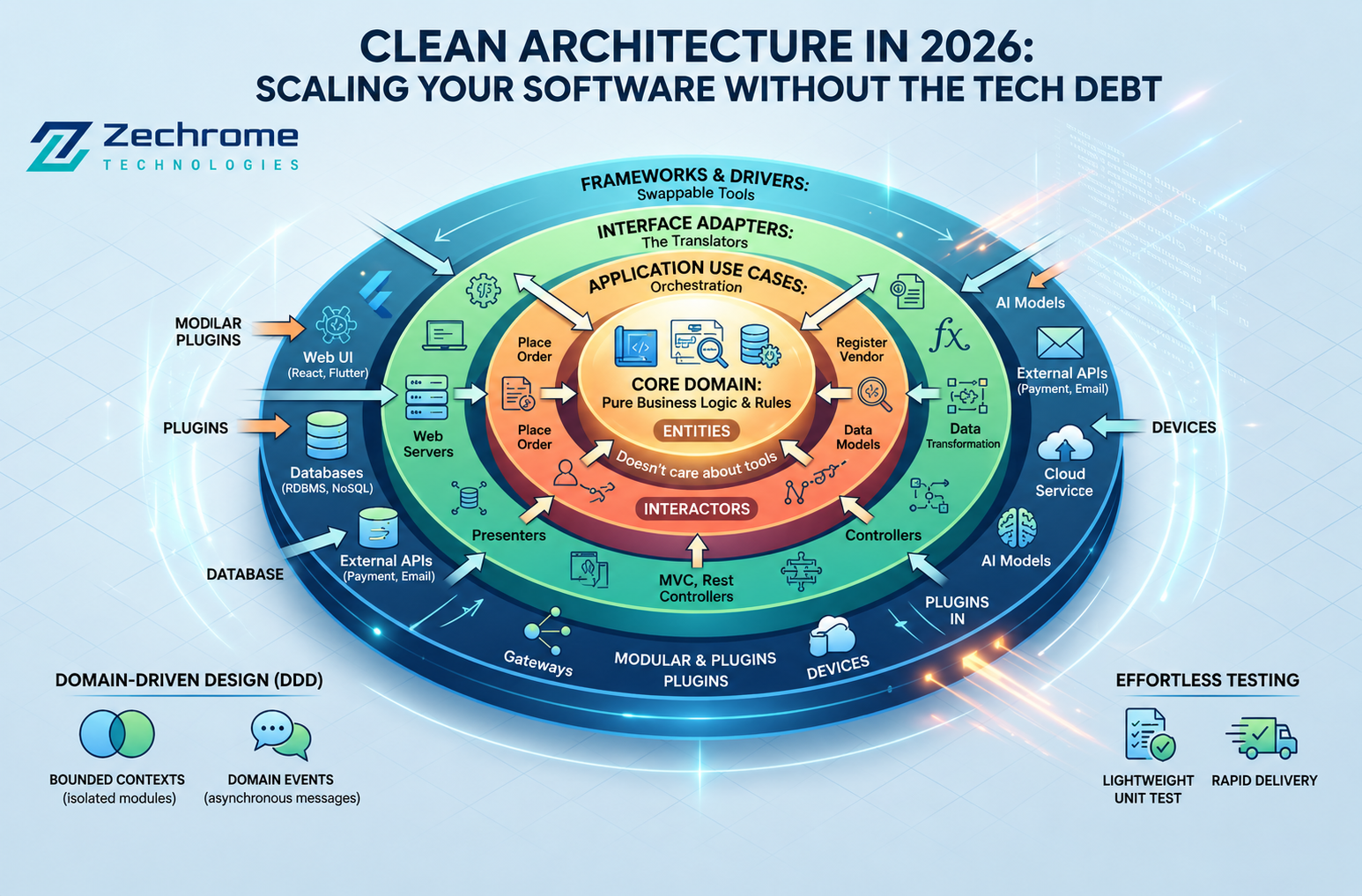
To keep a codebase clean after months of heavy feature additions, think of your software like an onion with layers. The golden rule here is that outer layers can talk to inner layers, but inner layers should never know what is happening on the outside.
Let’s break down how this works in real life:
1. The Core (The Heart of Your Business)
At the absolute center of your app lives your Core Domain. This contains the most fundamental rules of your business things like how a discount is calculated, or what fields a user profile must absolute contain. This layer is pure logic. It doesn’t care if you use PostgreSQL, MongoDB, React, or Flutter. It remains entirely untouched by tech trends.
2. Use Cases (The Coordinator)
The next layer out handles your specific application features, like PlaceOrder or RegisterVendor. It orchestrates the flow of data to and from the Core. It says, “When a user clicks this button, grab this business rule, validate it, and prepare the result.”
3. Adapters (The Translators)
This layer acts as a bridge. It takes data from the outside world (like a form submitted on a website or an API request) and converts it into a clean format that your Use Cases can understand.
4. The Outside World (The Swappable Tools)
The absolute outermost layer is where your actual database, web frameworks, and UI live. Because they are on the very edge, they are completely swappable. If you want to switch your web framework tomorrow, your core business logic doesn’t change by a single line.
Combating Spaghetti Content with Domain-Driven Design (DDD)
Separation of concerns keeps your layers organised from the inside out. But how do you prevent your app from becoming cluttered horizontally as you add dozens of new features? You use Domain-Driven Design (DDD).
At Zechrome Technologies, we use two primary DDD strategies to keep massive projects clean:
Bounded Contexts (Draw Clear Lines): Instead of creating one massive, confusing code file that tries to handle every part of the business, we split the app into distinct, isolated modules. The Billing system is kept completely separate from Inventory Management. They operate in their own bubbles, preventing accidental cross-contamination.
Domain Events (Talk via Messages): Instead of different parts of the software calling each other directly and getting tangled, they communicate using notifications. When a new vendor signs up, the system simply broadcasts, “New Vendor Registered!” Any other department that needs to know can listen and react on its own time.
The Secret Weapon: Effortless Testing
The ultimate proof of a Clean Architecture is how easy it is to test.
Because your core business rules are completely isolated from databases and external APIs, you don’t need to spin up a live database or run heavy cloud environments just to test if a feature works. You can write lightweight unit tests that run in milliseconds.
This gives your engineering team the confidence to ship updates rapidly. When you can test your core logic instantly, you eliminate the fear of breaking old features when deploying new ones.
Scalability is a Choice
Technical debt isn’t an inevitable curse of software development; it’s the result of compounding architectural shortcuts. By choosing Clean Architecture and Domain-Driven Design, you ensure that your software stays organized, adaptable, and ready for whatever the tech landscape throws at it next.
At Zechrome Technologies LLP, we specialize in translating complex corporate workflows into clean, reliable, and highly scalable software solutions. Whether you are launching a brand-new platform or refactoring a slow, legacy system, we engineer codebases built to stand the test of time.
What is the biggest bottleneck your team faces when scaling a codebase? Let’s discuss in the comments below! Want to future-proof your next software project? Connect with our team at Zechrome Technologies LLP.
