

At Zechrome Technologies LLP, we have always believed that the tools we choose define the quality of the solutions we deliver. For years, Django was the backbone of our development. It is a fantastic, “batteries-included” framework that allowed us to build and ship products quickly.
However, as we moved into 2026, the digital landscape changed. Our projects shifted from standard web apps to high-speed Industrial IoT systems and AI-driven automation. To keep up with these modern demands, we migrated our core services to FastAPI.
Here is a detailed look at why we made this switch and why it matters for the future of software.
1. Handling Thousands of Tasks at Once (Concurrency)
The biggest difference between the two is how they handle “work.”
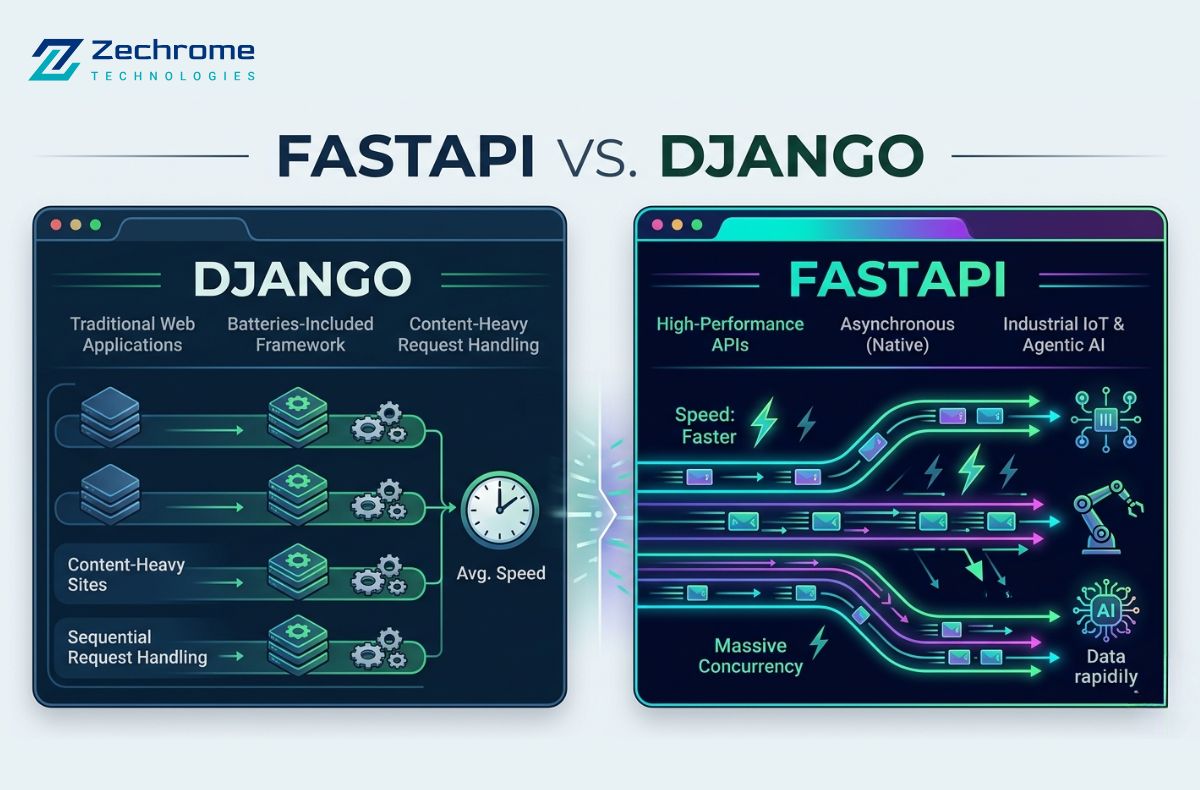
- Django was built at a time when web traffic was simpler. It handles one request at a time per worker. While it has improved, its “heavy” nature makes it harder to manage thousands of simultaneous connections from sensors or mobile devices.
- FastAPI is built for the modern era. It uses Asynchronous (Async) programming natively. This means the server doesn’t “wait” for one task to finish before starting the next. It’s like a waiter who takes five orders at once instead of waiting for the first table to finish their meal before talking to the second.
2. Speed and Low Latency
In 2026, a delay of even half a second can feel like an eternity to a user—or worse, it can cause a failure in a smart factory system.
When we ran our internal performance tests, the data was undeniable:
- Response Speed: FastAPI was nearly 7 times faster than Django in processing data.
- Throughput: FastAPI could handle roughly 9,000 requests per second, while Django struggled after 1,800.
For our clients, this means apps that feel “instant” and servers that never get “tired” during peak traffic.
3. Fewer Bugs with “Type Safety”
One of the most frustrating parts of software development is when an app crashes because someone entered a “word” where a “number” was expected.
FastAPI uses a system called Pydantic. It acts like a strict security guard at the door. If the data coming in isn’t exactly what the system expects, FastAPI stops it immediately and sends a clear message. Because this is built-in, our developers at Zechrome spend 40% less time fixing bugs and more time building new features.
4. Automatic Documentation
In the past, our team had to spend hours writing manuals (API documentation) so that different parts of a project could talk to each other.
With FastAPI, the documentation writes itself. As we write the code, a professional, interactive manual (Swagger UI) is generated automatically. This allows our frontend and backend teams to stay perfectly synced without extra meetings or paperwork.
5. Why This is Crucial for AI and IoT
At Zechrome, we are heavily involved in Agentic AI systems where AI “agents” perform tasks automatically. These agents need to send and receive data in milliseconds.
- Django often felt too “bulky” for these lightweight, lightning-fast interactions.
- FastAPI is lean. It provides exactly what is needed and nothing more, making it the perfect engine for AI logic and real-time sensor data.
When Do We Still Use Django?
We haven’t thrown Django away! It is still a world-class tool for specific jobs. We still recommend Django for:
- Content-heavy websites (like blogs or news portals).
- Internal Admin Tools where speed isn’t the top priority, but having a ready-to-use dashboard is.
Conclusion: Investing in the Future
The switch to FastAPI represents our commitment at Zechrome Technologies LLP to never settle for “good enough.” By adopting this technology, we are providing our partners with software that is:
- Faster for the end-user.
- Cheaper to run on servers.
- Easier to scale as the business grows.
Are you ready to build something that is ready for 2026 and beyond? Let’s discuss how our new FastAPI-powered architecture can boost your next project.
